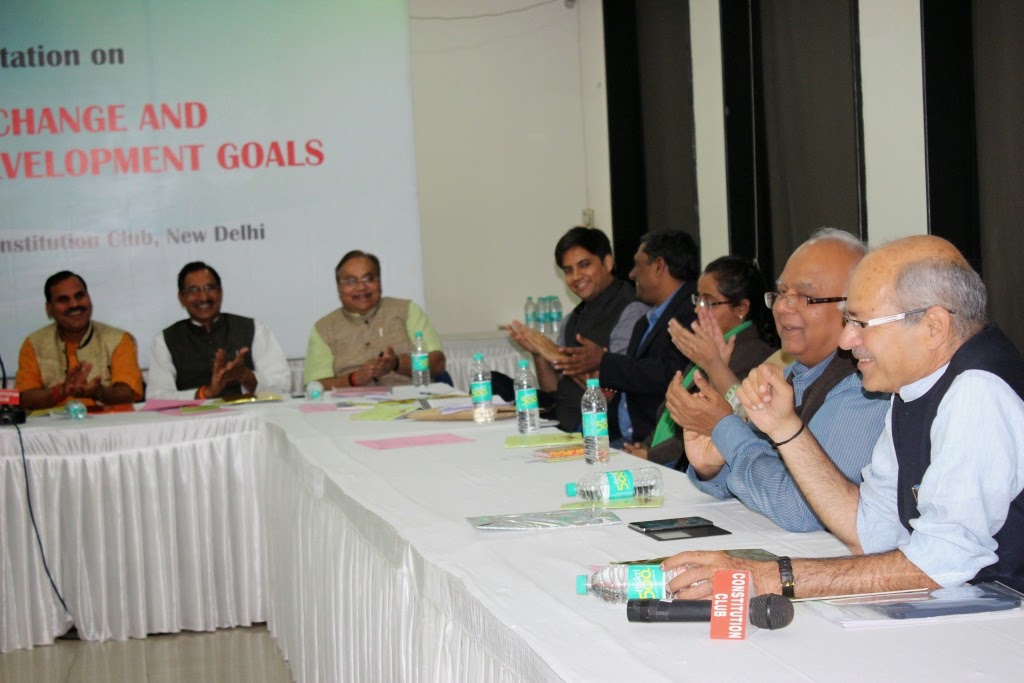
India’s National Response to Climate Change
Thursday, September 17, 2015 |
No Comments |

Ajay
K Jha
International
negotiations in climate change faces continued bottlenecks. Conference of
Parties, Annual High Level meetings of the United Nations Framework Convention
on Climate Change (only international treaty to ensure global cooperation
towards climate stabilization) and Meetings of Kyoto Protocol (CMP), which laid
down science based targets for the developed countries emission reduction) have
failed to lead to adequate mitigation efforts by the developed countries. The
Conference of Parties at Durban decided to have a new framework of
international cooperation where going beyond Kyoto Protocol, all developed and
developing countries are likely to contribute to mitigation and adaptation
doing away with the concept of Common but differentiated responsibility based
on respective capacity, which was bedrock of the equity consideration in the
climate change agreement. Without going into details of this proposed
transformation, it is highly unlikely that the new treaty will provide the
transformational shift, which is required to keep the rise in global
temperature below 1.5 or 2 degrees Celsius and 400 ppm of carbon concentration
in the atmosphere.
In the face of
global impasse, national and sub national policies on climate change are
becoming increasingly important. A number of developed and developing countries
have adopted policies and legislations at national and sub national levels to
reduce emissions and emission intensity. It is encouraging to see that
developing countries have taken a lead in adopting national and sub national
policies and offers on the tables show that developing countries are leading
the way in mitigation than the developed countries that have been primarily
responsible for bringing about this crisis. The current paper attempts to track
India’s progress on its national and sub national climate policies, and peoples
participation in the climate or environmental policies (or rather the lack of
it).
India’s Position in International Negotiations
India’s national
policy on climate has essentially drawn its reference from its international
position in climate negotiation and therefore, it would be worthwhile to have a
look at India’s stance at global climate negotiations.
India
has been one of the important countries to have acknowledged importance of
having development strategies integrated with objectives of environmental and
social protection. Mrs. Indira Gandhi was one the only Head of the State to
have participated in the famous Stockholm Conference (1972), which for the
first time brought environment on the global political agenda. Subsequently,
Rio Conference on Earth and Development (UNCED, 1992) reiterated this global
intention by listing impressive outcomes in the UN Convention on Biological
Diversity (UNCBD), UN Convention against Desertification (UNCCD), and UN
Framework Convention on Climate Change (UNFCCC), and Agenda 21. India played a
significant role in shaping global environmental policies. Nationally also
India enacted a slew of legislations for protection of environment,
biodiversity, water and ambient air etc. However, over the period there
has been a significant and perceptible shift in India’s policy and its position
in international negotiation, which has raised curiosity internationally, but
has also been subject to scathing criticism at home.
Having the advantage
of very low per capita emission of the GHG (1.6 per tone of carbon emission n
per capita, as opposed to 20 tonnes of the US, and 4 tonnes global average),
India initially harped on the per capita principle (right of countries to atmospheric
space should be determined on per capita emission basis) and refused to
acknowledge any role for developing countries and India in climate
stabilization efforts. Prime Minister of India declared in 2008 that India’s
per capita emission will never surpass those of the developed countries.
However, gradually India could understand that the position has led to its
isolation in the international community, and a shift was necessitated to
maintain its leadership role globally and among developing countries. Preceding
the Copenhagen COP Meeting (2009), India declared in the Major Economies Forum
Meeting at La, Aquila that India will reduce its emission intensity (emission
per unit of the GDP). In Copenhagen COP, following China’s declaration, India declared
that it would reduce its emission intensity by 20-25% (on a 2005 baseline) by
2020. Since then India has steadfastly guarded its position and India’s
domestic policies have also targeted 20-25% reduction in emission intensity,
and have been essentially based on India’s international pledge. The nature of
the current paper does not allow us to go deeper to explore whether this target
is ambitious enough, however, it will suffice to say that many countries have
understood that having ambitious climate policies is in their national
interest, and have gone beyond their international pledges and adopted more
ambitious national and sub national policies.
India’s National Action Plan on Climate Change and Recent Developments
Prime Minister of
India declared a National Action Plan on Climate Change (NAPCC) on 30th June
2008. The NAPCC laid down 8 Missions as; National Solar Mission, Mission on
Enhanced Energy Efficiency, Mission on Sustainable Habitat, Green India
Mission, National Water Mission, National Mission on Sustainable Agriculture,
National Mission on Sustainable Himalayan Ecosystem and National Mission on
Strategic Knowledge.

The NAPCC attracted
severe criticisms from the civil society and the experts. It was alleged “the
NAPCC has been formulated through a most non transparent manner, and it will
neither benefit people or the climate.”[1]
It was alleged that NAPCC does not question the current non sustainable, high
emissions pattern of economic development. This must include differentiated
ecozone planning, district level vulnerability and contingency planning for
disasters, industry based reduction of emissions, and peoples control
mechanisms over the commons.[2]
Other criticisms were based on lack of clarity on goals, targets and timelines,
lack of prioritization, and complete lack of equity.[3]It
was dubbed as a wish list without any roadmap. Women’s organizations criticized
it for being insensitive to gender concerns in the climate change.
Even after 5 years
of being launched, there has been no systematic review or assessment of the
NAPCC by the government. An informal stocktaking of the NAPCC, in late 2011,
summed up the developments as “many of the missions except solar mission,
energy efficiency, green India, water mission have failed to take off due to
lack in the clarity of targets at operational level.” Planning Commission
working group, while formulating 12th FYP suggested merging many missions and
scrapping few, for the lack of financial resources and implementability. An
assessment done by the IIT Madras and IIT Mumbai groups (2011-12) reiterated
the lack of clarity on targets, timelines, modalities and financial resources,
as major constraints hampering the implementation of the NAPCC.[4]As
a matter of fact, only few missions of the NAPCC have moved forward as
expected.
Jawaharlal Nehru
Solar Mission has registered an impressive growth, and has achieved the target
of generating 1000 MW of solar PV in the first phase (2010-2013). However, the
progress on off grid and solar thermal has remained limited with solar thermal capacity
creation of only 5.5 MW against the target of 470 MW. However, the achievements
have been marred by gaps in the policy and regulatory lapses. LANCO cornered
1/3rd of the projects (235 MW) in the first phase by operating through many
front companies of dubious credentials, while the target was to limit the
participation to 20 MW-40 MW, so as to prevent monopolistic practices in the
solar sector. Flawed policies and lack of emphasis on domestic content
requirement (DCR) also resulted in most capacity creation through imports
rather than enhancing domestic capacity, and focusing on big projects it
neglected people participation through small cooperatives. The Solar Mission is
the most expensive solar programme of the world (will require 2 lakhcrore of
investment of public money).[5]As
far as domestic capacity creation is concerned, it is wilting under US and
Chinese competition. The big players in the solar market have lobbied against
DCR as it might increase their costs.[6]
The National Mission
on Enhanced Energy Efficiency has also witnessed a major progress. Partial Risk
Guarantee Fund (PRGF) and the Venture Capital Fund for Energy Efficiency
(VCFEE) set up as incentives for companies to achieve emission efficiency. PAT
(Perform, achieve and trade) was launched as another incentive on the lines of
the Cap and Trade Scheme of the USA. Under the PAT specific energy consumption
(SEC) targets have been identified for designated consumer (DC) companies
across 8 sectors, with targets to be achieved by 2014-2015. Bureau of energy
efficiency (BEE) has also framed labeling standards for a number of home
appliances. However, it also remains beset with many problems; viz. focus on EE
without integration with R&D, poor coordination with states, PAT is
available only for big companies, not SMEs while Indian industry is dominated
by SMEs.
National
Water Missions seeks to introduce water use efficiency of 20%. However, it is largely focused on mountain watersheds and wetlands, with
little concerns for water demand management and irrigation. The mission
continues with age old model of centralized water resource development
projects, long distance water transfers and canal irrigation. Emphasis could
have been better laid on developing and strengthening local authorities for
management of water resources. The mission also reveals poor inter disciplinary
coordination and fails to capture the complexity of the domain. The only
benefit that mission provides to the people is that it promises to put all data
related to water use in public domain.[7]
There has been little progress besides release of some policy documents,
National Water Mission, restructuring of Central Water Commission, and draft
Guidelines for development of water use efficiency in rural, urban, industrial
and irrigation sector, web enabled water resources information system of India
(India-WRIS), are few things that the Mission could achieve till now.
The Mission on Green
India has progressed faster than the NAPCC, because of lure of international
funding that India looks forward to seek from REDD+ Programme. However, the
achievements have been limited on the ground. The states were supposed to
provide bridge plans (by the end of 2011) and five to ten years perspective
plans (by Feb 2012), which they are yet to submit. The state governments are
also supposed to identify land and seek funding. A fund of INR 45,00 crore per
annum has been earmarked for the GIM, any additional support required is
planned to be met from external funding. Ministry of finance has allocated INR
500 crore from the National Clean Energy Fund (NCEF) for the bridge plan and
for the GIM.[8]
Union Budget 2011-2012 announced INR 200 crore as the take off fund for the
GIM. However, recent developments suggest fast movement and MOEF is organizing
one workshop in each state every month on REDD + preparedness. All the SAPCCs
are also bent upon earning money from REDD + Programme.
National Mission on
Sustainable Agriculture seeks to mainstream mitigation and adaptation in
agriculture through a number of centrally sponsored schemes namely National
Food Security Mission, National Horticulture Mission, Rashtriya Krishi Vikas
Yojana. The Mission was launched with the 12th Five Year Plan in 2012. The
mission is highly technology driven and promotes GMOs, Bio-fuel, no till
agriculture, which is not in consonance with the reality of the small and
marginal farmers. There is very little support for adaptation, risk insurance
and coverage etc. also there was no coordination between centre and states and
centre having no control over state projects and priorities. The mission is so
much obsessed with improving water use efficiency in irrigation so it spent INR
950 crore out of the budget of INR 13500 crore on drips and sprinklers!!
Besides, these
missions there have been almost no development in the rest of the missions
worth mentioning.
Sub National Plans; State Action Plan on Climate Change[9]
The
MOEF asked the states of formulate State Action Plan on Climate Change (SAPCC)
to support the NAPCC in Aug 2009. States started reluctantly to formulate the
SAPCCs after flunking many deadlines. By now over 20 states are in the various
stages of formulation and submission. 5 SAPCCs (MP, Rajasthan, Sikkim, Tripura,
Arunachal Pradesh) have been approved by National Steering Committee on Climate
Change and 6 SAPCCs (AP, Assam, Mizoram, Meghalaya, Odisha, West Bengal) are
under consideration by the Expert Committee. Many coastal and highly vulnerable
states like Gujarat, Tamilnadu and Kerala, and Maharashtra are yet to submit
their plans. Most of the plans are based on the
framework of the NAPCC, have a very wide sweep and include energy, agriculture,
water, forests, urban development, health, animal husbandry, energy efficiency
etc.
A
peep in the SAPCCs manifests that it is highly non
transparent and top down. No information is available even with the MOEF regarding the
process and timeline. It has been essentially a consultant driven and
bureaucratic exercise, with no ownership of the states. Except in the MP,
nowhere meaningful consultation with experts, affected communities, civil
society has taken place. There is no deadline, no clarity till when and how
plans will be finalized, what is the basis. There is also huge amount of
hankering over finances to implement the plans.
Most
of the plans have no concern for equity, rights of people and gender. Plans do
not talk at all about increasing access and equity in energy, water or natural
resources. They also remain equally insensitive to gender concerns in climate
change. None of them even mention the UN Declaration on the Rights of
Indigenous Population (UNDRIP). Many of the states are being helped by World
Bank, UNDP, DFID, GIZ etc. and have clear imprints of international
negotiations rather than local concerns and priorities. Most of the states have
actually developed these plans without any mapping, vulnerability assessment of
regions or sectors. States either do not have much vision in missions on energy
efficiency, industries, health, livelihoods and urban planning. None of the
plans show even scant affinity with the people who are being affected due to
climate change impacts. Most of these plans pay lip service to agriculture and
food security. While most of
the states acknowledge importance of agriculture many of them propose actions
which will harm agri and endanger Food Security. Plans talk about “modern
scientific agriculture”[10] propose a set of actions to improve
agriculture including “modernization of agriculture, biotechnology, seed
replacement increased use of fertilizers….,”[11]and “zero tillage agriculture”[12] etc. Rajasthan includes “exploring
carbon sequestration potential of carbon deficient soil” and “increased use of
biotechnology”. Odisha has also given extensive treatment to agriculture in the
plan however; it failed to allocate single Rupee to agriculture in the first
draft! As far as agriculture is concerned, “it’s more
of the same” except for some research proposed for vulnerability mapping for
specific agro-climatic zones and crops.”[13] The actions suggested will harm
small holder farmers and endanger food security than enhancing it.
SAPCC
have been criticized for being consultant driven, having inappropriate
procedure, process and institutional arrangements, and lack of vision on
implementation and funding. Till now none of the states have started
implementation, and there is no timeline declared. Financing has been the most
knotty issue with states expecting big money from the central government, while
central government wants them to depend on their own resources. States have
failed to make a robust financing plan for the implementation of the SAPCC. While Odisha’s
estimated budget for climate change is INR 17,000 crore, West Bengal’s budget
is more than INR 30,000 crore (excluding many activities that don’t have budget
estimates) and Haryana’s is around INR 50,000 crore. Sikkim has allocated
nearly INR 7000 crore on improving floriculture activities and INR 10,000 crore
on replantation for area expansion under the cardamom programme (next 10 year
period). This accounts for almost 20% of the budget for the national Mission
for Sustainable agriculture (NMSA) for 2011-2016. Haryana proposes to use INR
15,000 crore on energy efficiency in agriculture, which is more than 15% of the
NMSA budget for 2011-2016.
According
to recent estimates, the NAPCC will require INR 230,000 Crore (USD 37.16
billion). There is very little clarity on how it will be mobilized. Similarly
with SAPCCs, there is very little understanding on whether the state government
will be provided any resource to implement SAPCCs, and how the centre will
determine vulnerability and establish equity between the states in providing
finances. Finance besides institutional arrangement, monitoring, and
interdepartmental cooperation are going to be major challenges in
implementation of the State Action Plans.
Reference
The paper was prepared for the APRN Biennial
Conference, 1st to 4th September, Hong Kong. It draws
from an earlier paper of the author “Reflections on the National and Sub
national Climate Policies of India; Leader Abroad and Laggard at Home”
(Occasional Paper Series, published by PAIRVI, Nov 2013)
[1] There is little Hope, South Asia Network on Rivers
and Dam, August, 2008
[2]
Coalition for Dignity and Survival, 2010.
[3]
NAPCC between Devil and Deep Sea, Ajay K Jha, Occasional Paper Series, Paper
Series, PAIRVI, August 2008
[4]
National Action Plan on Climate Change, IFMR, 2012
[5]
Centre for Science and Environment, 2013
[6]
TOI, Delhi, June, 2014
[7] There is Little Hope, SANDRP, 2008
[8] NCEF has been created by putting
a cess of USD1 per ton of coal (both imported and domestic), lies largely
unused due to lack of innovative renewable energy projects.
[9] This section is largely based on the authors previous
critique on SAPCCs titled “Much Ado about State Action Plans; they are business
as usual” published as Occasional Paper Series of PAIRVI in 2012.
[10] Manipur State Action Plan on
Climate Change
[11] Madhya Pradesh State Action Plan
on Climate Change
[12] West Bengal State Action Plan on
Climate Change
[13] “Much Ado about State Action
Plans; they are business as usual” published as Occasional Paper Series of
PAIRVI in 2012.